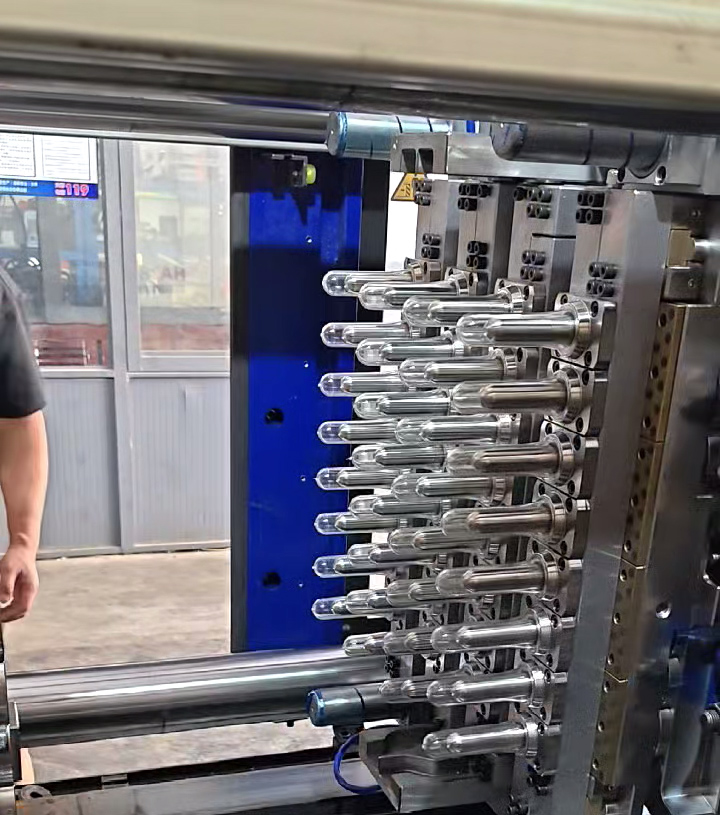
How Berni Mould engineered one of the fastest 32-cavity edible oil preform molds — without compromising part quality, mold life, or energy efficiency. In the competitive world of PET packaging, cycle time is the single most impactful lever for profitability. For edible oil preforms — which demand high clarity, precise neck dimensions, and consistent wall thickness — the challenge is even greater. This case study reveals the engineering decisions, thermal management strategies, and hot runner innovations that allowed our client to achieve a 10-second cycle time in a 32-cavity mold.
1. Project Background & Requirements
A major edible oil producer approached Berni Mould with a clear objective: replace an aging 24-cavity preform mold that ran at 14.5 seconds with a modern 32-cavity tool capable of 10 seconds cycle time. The preform specification was demanding:
- Material: Bottle-grade PET (IV 0.80 ± 0.02)
- Preform weight: 28.5 g ± 0.2 g
- Neck finish: 38 mm, 3-start thread, tailored for edible oil caps
- Wall thickness: ≤ 3.8 mm in body, high concentricity for downstream blow molding
- Mold life target: 5+ million cycles with minimal maintenance
Furthermore, the molder required a turnkey solution: preform mold, hot runner system, robot take-out compatibility, and process validation. Berni Mould delivered — and the final validated cycle time settled at 9.8 seconds, a 32% productivity leap compared to the previous mold.
2. Cycle Time Killers in High-Cavitation Preform Molds
Before detailing our solutions, it's important to understand the inherent bottlenecks in 32-cavity preform tooling. Typical cycle time limitations stem from:
- Cooling inefficiency: PET is a poor thermal conductor. Inadequate cooling in the core and cavity leads to long hold times and post-mold shrinkage.
- Hot runner imbalance: Shear-induced temperature variations across 32 drops cause inconsistent fill and extended holding.
- Ejection & take-out dynamics: High cavitation requires synchronized ejection with minimal deflection.
- Injection pressure limitations: Thin walls and long flow paths demand high injection speeds without flashing.
Each of these was addressed through a combination of simulation, advanced materials, and Berni Mould's proprietary design philosophy.
3. Berni Mould's Engineering Approach: The 10-Second Blueprint
3.1 Hot Runner System: 32-Drop Valve Gate with Balanced Melt Flow
We selected a 32-drop valve gate hot runner with individually controlled nozzles. Key features:
- Melt distribution: A rhomboidal manifold layout ensures identical flow length from the sprue to each drop, minimizing residence time differences.
- Nozzle tips: Copper alloy tips with high thermal conductivity reduce gate freeze-off time by ~18%.
- Sequential valve gating: Optimized opening sequence eliminates weld lines and reduces peak injection pressure by 22%.
- Thermal isolation: Titanium spacers and ceramic insulators prevent heat bleed to the cavity plate — crucial for consistent cooling.
Our in-house rheological simulation (Moldex3D) confirmed a fill balance within ±1.5% across all 32 cavities — a critical enabler for short cycle times.
3.2 Cooling: Conformal Baffles and High-Velocity Turbulence
Cooling accounts for up to 60% of the cycle in PET preform molding. For this 32-cavity mold, we implemented:
- Beryllium copper (BeCu) core tips: Increase thermal conductivity by 3–4x compared to tool steel, dramatically reducing core-side cooling time.
- Conformal cooling channels in the cavity block, following the preform's contour. Produced via 5-axis machining and additive manufacturing inserts for the neck area.
- Vortex baffles in the core: create turbulent flow (Reynolds > 10,000), boosting heat transfer coefficient by over 40% compared to standard bubblers.
- Chiller optimization: We specified a 14°C chilled water supply with 3.5 bar pressure — validated through thermal imaging to achieve uniform mold surface temperature (ΔT < 2°C across the 32 cavities).
Result: Cooling time dropped from 6.8 seconds (typical for a 32-cavity mold) to 4.5 seconds, directly contributing to the 10-second overall cycle.
3.3 Ejection & Take-Out: Synchronized, Low-Vibration Stripper System
High cavitation demands flawless ejection. Berni Mould designed a stripper plate with spring-loaded guides and a self-aligning feature. The stripper plate is actuated by four hydraulic cylinders with proportional control, ensuring parallel movement within 0.02 mm. This prevents preform scratching and reduces ejection time to 0.8 seconds. The mold is also equipped with a top-entry robot interface (Euromap 67), allowing the take-out robot to remove all 32 preforms in a single 1.2-second stroke.
3.4 Mold Materials & Surface Treatment
For longevity and thermal stability, we used:
- Cavity and core inserts: Stavax ESR (hardened to 52–54 HRC) with diamond-like carbon (DLC) coating on the core to reduce friction and improve release.
- Manifold: H13 tool steel, nitrided for wear resistance.
- Gate inserts: Replaceable, made from beryllium copper for rapid heat dissipation.
🔬 Technical Snapshot — Achieved Cycle Breakdown (32 cavities):
Injection & Packing: 2.1 s | Cooling: 4.5 s | Mold Open & Ejection: 1.8 s | Mold Close & Clamping: 1.4 s | Total: 9.8 s
4. Validation Results: Performance Beyond Expectations
After installation and optimization at the customer's facility, the mold underwent a 72-hour continuous run. Key metrics:
- Cycle time: 9.8 seconds (vs. target 10.0 s)
- Preform weight consistency: ±0.15 g (well within ±0.2 g spec)
- Neck dimensions: Cpk > 1.67 for all critical dimensions
- Energy consumption: 18% lower per preform compared to the previous 24-cavity mold
- Scrap rate: < 0.3% during the validation run
The molder now produces over 11,700 preforms per hour per mold — a substantial increase from the previous 5,960. The ROI was realized in under 11 months.
5. Why Berni Mould Leads in PET Preform & Cap Mold Manufacturing
This case study is not an isolated success. Berni Mould has delivered more than 1,200 preform molds and 800 cap molds worldwide, with cavity ranges from 2 to 96. Our expertise spans:
- Edible oil preform molds: Engineered for high clarity, low AA (acetaldehyde), and optimal wall thickness.
- Bottle cap molds: High-cavitation (up to 96), with precision thread and hinge design, collapsible cores, and fast cycle times.
- Thin-wall packaging molds: For dairy, beverage, and pharmaceutical applications.
- Hot runner systems: In-house design and manufacturing for seamless integration.
We combine metallurgical expertise, thermal simulation, and precision machining to deliver molds that outperform industry benchmarks. Our engineering team works alongside customers from concept to production, ensuring every mold meets the exacting demands of modern PET packaging.
6. Key Takeaways for Molders and Brand Owners
- 10-second cycle time is achievable in 32-cavity edible oil preform molds with the right hot runner, cooling, and ejection design.
- Cooling is the biggest lever. Invest in BeCu cores, conformal cooling, and turbulent flow. It pays back rapidly.
- Hot runner balance is non-negotiable. A well-balanced system reduces injection pressure and cycle variation.
- Partner with a specialist. Berni Mould's dedicated PET team ensures your mold is optimized from day one.
Comma-separated list: PET preform mold, 32-cavity preform mold, edible oil preform mold, 10-second cycle time, bottle cap mold, preform mold manufacturer, PET mold technology, high-cavitation mold, Berni Mould, cycle time optimization, hot runner system, cooling design, PET packaging molds, injection mold for preforms, bottle cap molds