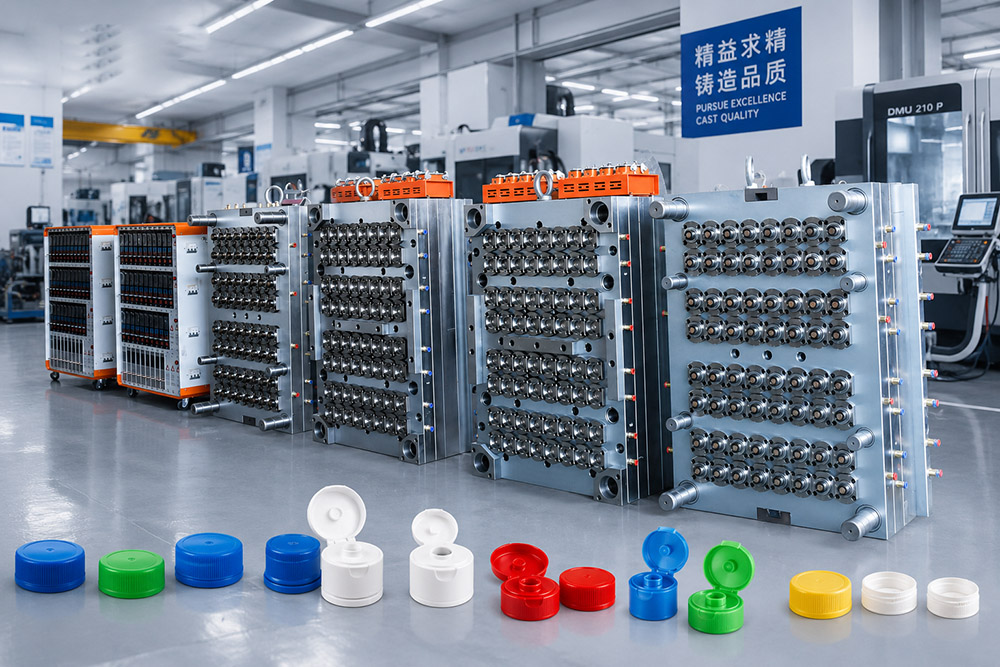
1. What Is the Difference Between a Hot Runner and a Cold Runner?
The fundamental difference is how molten plastic is delivered from the injection machine nozzle to the mold cavities.
Hot Runner Mold
A hot runner system uses a heated manifold and heated nozzles to keep the polymer molten while it travels toward the mold cavities. Because the runner remains hot, the runner material does not normally solidify and become part of the ejected molding.
This architecture can significantly reduce runner waste and can improve production efficiency in high-volume applications. However, the system requires additional components such as heaters, temperature sensors, controllers, manifolds and specialized hot runner nozzles.
Cold Runner Mold
A cold runner system uses unheated channels machined into the mold. During every injection cycle, the plastic inside the runner cools and solidifies together with the molded part. The runner must then be separated from the product and either recycled, reground or discarded.
Cold runner molds generally have a lower initial tooling cost and simpler construction. They can therefore be an economical solution for lower-volume production, applications requiring frequent material or color changes, or projects where the initial mold budget is the dominant consideration.
2. Hot Runner vs. Cold Runner: Direct Comparison
| Factor | Hot Runner Mold | Cold Runner Mold |
|---|---|---|
| Initial Mold Cost | Higher | Lower |
| Runner Waste | Very low / practically eliminated during stable production | Generated every cycle |
| Material Utilization | Excellent | Lower because of runner material |
| Cycle Time | Potentially shorter because there is no cold runner to cool | Runner cooling can contribute to cycle time |
| Mold Complexity | Higher | Lower |
| Maintenance | Requires hot runner and temperature-control expertise | Relatively simple |
| High-Volume Production | Highly suitable | May become less economical |
| Frequent Color Changes | More demanding | Generally easier |
| Multi-Cavity Production | Excellent when properly balanced | Possible, but runner design becomes more material-intensive |
| Long-Term Production Cost | Can be significantly lower in high-volume applications | Can increase because of runner waste and longer cycles |
3. Why Hot Runner Technology Is Important for Plastic Cap Molds
Plastic bottle caps are ideal examples of products where runner system selection can have a major economic impact. A cap may weigh only a few grams, but a production line can manufacture millions or even hundreds of millions of caps over the service life of a mold.
When a cold runner is used, additional polymer is required to fill the sprue and runner system. The amount may appear insignificant in one cycle, but the accumulated material loss becomes substantial when multiplied by millions of cycles.
For example, consider a hypothetical production system where the total runner waste is 5 grams per cycle. At 1 million cycles, this represents approximately:
5 g × 1,000,000 cycles = 5,000 kg of runner material
The actual waste percentage depends on the product weight, runner design, number of cavities and process conditions. The example demonstrates why runner design should be evaluated based on the complete production volume rather than only the initial mold quotation.
For high-volume bottle cap production, eliminating or greatly reducing runner waste can become one of the strongest economic arguments for a hot runner system.
4. The Real Cost of a Mold Is More Than the Purchase Price
A common mistake in mold purchasing is comparing only the initial mold quotation. The correct approach is to evaluate the Total Cost of Ownership (TCO).
A practical TCO model for a plastic cap mold can include:
- Initial mold purchase price
- Hot runner system cost
- Injection machine operating cost
- Plastic material consumption
- Runner scrap and recycling cost
- Cycle time
- Electricity consumption
- Operator requirements
- Maintenance cost
- Spare parts
- Downtime
- Expected mold service life
- Annual production volume
Therefore, a mold with a higher purchase price can still be the more economical solution if it reduces material consumption and increases production efficiency over a long production program.
5. Initial Investment: Why Cold Runner Usually Costs Less
The main advantage of a cold runner mold is its relatively simple structure. The mold does not require a heated manifold, temperature controller, thermocouples or heated nozzles.
As a result, the initial tooling investment can be lower. This can be attractive for:
- Low-volume production
- Prototype production
- New products undergoing market testing
- Projects with strict initial investment limits
- Applications requiring frequent material or color changes
However, the lower purchase price should not automatically be interpreted as a lower production cost. If the mold runs continuously for several years, material waste and cycle-time differences can outweigh the initial tooling savings.
6. Material Waste: The Most Important Economic Difference
Material efficiency is particularly important for plastic packaging products because resin represents a major portion of the production cost.
In a cold runner mold, the runner solidifies during every cycle. Even when the runner is reground and recycled, additional handling, grinding, storage and process control may be required.
In a hot runner mold, the polymer remains inside the heated delivery system and is injected directly into the cavity. This substantially reduces the amount of runner material that has to be removed from every molding cycle.
For applications using expensive engineering polymers, recycled-material restrictions or strict appearance requirements, material utilization can become an even more important design factor.
7. Cycle Time and Production Capacity
Cycle time is another critical variable in cap mold economics. In a cold runner system, the runner must cool sufficiently before the mold can open and eject the molded components.
A properly designed hot runner eliminates the need to cool a solidified runner. This can allow the mold designer to optimize the cooling system around the actual plastic part rather than the runner.
However, it is important to avoid a common misconception: a hot runner does not automatically guarantee a shorter cycle time.
The final cycle depends on many factors, including:
- Part wall thickness
- Resin grade
- Injection pressure
- Cooling channel design
- Mold steel
- Gate design
- Injection machine performance
- Part ejection system
- Cooling water temperature and flow
Therefore, an experienced mold manufacturer should optimize the entire injection system instead of focusing only on the runner.
8. Why Multi-Cavity Cap Molds Need Flow Balance
As cavity numbers increase, runner balance becomes increasingly important. In a multi-cavity cap mold, every cavity should receive the correct amount of molten polymer at a controlled pressure and temperature.
An unbalanced runner system can result in:
- Different filling times between cavities
- Variation in part weight
- Different packing conditions
- Dimensional variation
- Inconsistent gate appearance
- Different shrinkage behavior
- Higher rejection rates
For high-cavity plastic cap molds, the hot runner manifold must therefore be engineered for proper flow distribution. Runner geometry, nozzle configuration, gate size, melt temperature and pressure balance all contribute to multi-cavity consistency.
This is one reason why a high-quality multi-cavity cap mold is much more than a collection of identical cavities. The entire mold is an integrated injection system.
9. Hot Runner Technology in PET Preform Molds
PET preform molds have even more demanding requirements than many conventional plastic injection molds. PET preforms are commonly produced using multi-cavity molds, and the preform must maintain accurate neck dimensions, wall distribution, gate quality and weight consistency.
Hot runner technology is widely used in high-cavity PET preform mold systems because the injection system must deliver PET melt consistently to multiple cavities.
For PET preform production, important engineering considerations include:
- Hot runner flow balance
- Gate design
- Preform weight consistency
- Neck finish accuracy
- Cooling efficiency
- Thermal stability
- Injection pressure distribution
- Cavity-to-cavity consistency
- Cycle time
- Easy maintenance and component replacement
High-cavity PET preform mold manufacturers commonly combine optimized hot runner technology with independent cooling structures to reduce cycle time and improve cavity consistency. Cooling channel design is especially important because efficient cooling directly affects cycle time and preform dimensional stability.
10. Hot Runner Is Not Always the Best Choice
A professional mold manufacturer should not recommend a hot runner simply because it is technically more advanced. There are situations where a cold runner mold is the more practical solution.
Cold Runner May Be Better When:
- Annual production volume is relatively low.
- The customer needs the lowest possible initial mold investment.
- Frequent color changes are required.
- The material is sensitive to thermal degradation.
- The production facility has limited hot runner maintenance capabilities.
- The product geometry is simple and runner waste is relatively small.
- The project is primarily for sampling or short production runs.
Hot Runner May Be Better When:
- Production volume is high.
- The mold has many cavities.
- Resin cost is significant.
- Material waste must be minimized.
- Cycle time is a major production target.
- Automatic production is required.
- Consistent cavity filling is critical.
- The mold will operate continuously for a long service life.
11. How to Calculate the Hot Runner Break-Even Point
The most useful financial question is not: "How much more expensive is the hot runner mold?"
The better question is: "How many parts must be produced before the additional hot runner investment is recovered?"
A simplified calculation can be expressed as:
Break-Even Production Volume = Additional Hot Runner Investment ÷ Savings Per Part
Where savings per part can include:
- Reduced resin consumption
- Reduced runner waste
- Reduced cycle time
- Higher production output
- Lower labor requirements
- Reduced downstream runner separation
For example, assume a hot runner system increases the initial mold investment by USD 20,000. If the hot runner solution saves an average of USD 0.002 per cap through material savings and production efficiency, the simplified break-even volume is:
USD 20,000 ÷ USD 0.002 = 10,000,000 parts
This is only an illustrative calculation. Real projects should use actual resin prices, runner weight, cycle time, cavity number, machine hourly cost and expected annual production.
At Berni Mould, this type of production-oriented calculation is more useful than comparing mold quotations alone.
12. Maintenance: The Hidden Cost of Hot Runner Systems
One of the disadvantages of hot runner molds is increased technical complexity. A hot runner system includes electrical and thermal components that are not present in a basic cold runner mold.
Typical maintenance items may include:
- Heaters
- Thermocouples
- Hot runner nozzles
- Manifold components
- Valve gate components where applicable
- Temperature controllers
- Electrical connections
- Sealing components
For this reason, hot runner mold design should consider maintenance accessibility from the beginning. A high-performance mold that is difficult to disassemble or diagnose can create unnecessary downtime.
Berni Mould focuses on not only initial mold performance but also serviceability, replacement of wear components and long-term production stability.
13. Gate Design Is Critical for Bottle Cap Molds
The gate is one of the most important areas of a plastic cap mold. Gate location and gate geometry affect filling behavior, part appearance, stress distribution and downstream performance.
For bottle caps and functional closures, gate design should be evaluated together with:
- Cap geometry
- Wall thickness
- Material type
- Number of cavities
- Injection pressure
- Required cycle time
- Automatic demolding requirements
- Gate appearance requirements
A well-designed hot runner system can provide controlled melt delivery directly to each cavity. However, the gate still needs to be engineered correctly. Hot runner technology cannot compensate for poor gate design.
14. CAP MOULD Selection: What Should Buyers Tell the Mold Manufacturer?
When requesting a quotation for a plastic cap mold, customers should provide more than a cap drawing. The following information helps the mold manufacturer select the correct technology:
- Cap drawings or 3D files
- Cap material, such as PP or HDPE
- Cap weight
- Neck finish specification
- Annual production volume
- Required number of cavities
- Injection molding machine model and specifications
- Target cycle time
- Automatic or manual production requirements
- Color requirements
- Expected mold service life
- Preferred hot runner system, if any
With this information, the mold manufacturer can evaluate the best balance between tooling investment and production economics.
15. CAP MOULD Applications Suitable for Berni Mould
Berni Mould focuses on customized plastic cap mold solutions for different packaging applications. Depending on product geometry and production requirements, our engineering approach can cover:
- Mineral water bottle cap molds
- Beverage bottle cap molds
- Oil bottle cap molds
- Functional cap molds
- Flip-top cap molds
- Cosmetic cap molds
- Chemical packaging cap molds
- Wide-mouth closure molds
- Customized plastic closure molds
- High-cavity production cap molds
The final cavity count, runner system and gate configuration are selected according to the actual cap design and production target rather than using a one-size-fits-all mold structure.
16. PET Preform Mold Applications
In addition to plastic cap molds, Berni Mould provides engineering solutions for PET preform molds. PET preform tooling requires extremely accurate cavity alignment, cooling performance, neck finish control and injection balance.
Typical PET preform applications include:
- Mineral water bottle preforms
- Carbonated beverage bottle preforms
- Edible oil bottle preforms
- Cosmetic packaging preforms
- Wide-mouth PET preforms
- Jar preforms
- Industrial PET packaging preforms
- Customized PET preforms
For high-cavity PET preform production, hot runner balance and cooling efficiency become particularly important because even a small cavity-to-cavity difference can affect preform weight, dimensions and subsequent blow molding performance.
17. Hot Runner vs. Cold Runner: Decision Matrix
| Production Requirement | Recommended Direction | Reason |
|---|---|---|
| Low-volume production | Cold Runner | Lower initial tooling investment |
| Millions of caps per year | Hot Runner | Lower material waste and better production economics |
| High-cavity cap mold | Hot Runner | Better suited to balanced high-output injection systems |
| Frequent color changes | Cold Runner may be preferable | Simpler material and color change process |
| Expensive resin | Hot Runner | Improved material utilization |
| Very low tooling budget | Cold Runner | Lower initial mold cost |
| High-speed automatic production | Hot Runner | Designed for high-output manufacturing |
| High-cavity PET preform production | Hot Runner | Flow balance and material efficiency are critical |
18. The Most Important Principle: Design the Mold Around the Production Goal
There is no universal answer that says every plastic cap mold should use a hot runner. Likewise, cold runner technology should not be considered outdated simply because hot runner systems offer more advanced thermal control.
The correct engineering decision depends on the complete production scenario.
A professional mold manufacturer should evaluate:
- Product geometry
- Material
- Part weight
- Cavity number
- Production volume
- Cycle time
- Machine capacity
- Material cost
- Maintenance capability
- Mold lifetime
- Customer's investment strategy
The objective is not simply to manufacture a mold. The objective is to create a stable production system that delivers consistent parts at the lowest practical total cost.
19. Why Choose Berni Mould for Plastic Cap Molds and PET Preform Molds?
Berni Mould is a professional mold manufacturer specializing in plastic cap molds and PET preform molds. Our engineering focus is built around precision tooling, multi-cavity production, injection balance, cooling efficiency and long-term production reliability.
For customers purchasing a cap mold or PET preform mold, the mold itself is only one part of the investment. The real objective is to achieve stable production, consistent cavity performance, low material consumption and predictable maintenance over the mold's service life.
Berni Mould works with customers to evaluate the relationship between product design, cavity count, injection system, mold structure and production target. This allows us to develop customized mold solutions instead of simply offering a standard mold configuration.
Whether the project requires a plastic bottle cap mold, functional cap mold, flip-top cap mold, wide-mouth cap mold, high-cavity cap mold or PET preform mold, the correct runner system should be selected based on engineering requirements and total production economics.
20. Conclusion: Hot Runner or Cold Runner?
The hot runner versus cold runner decision is ultimately a question of production economics.
Cold runner molds offer lower initial investment, simpler construction and easier maintenance, making them attractive for lower-volume applications and projects where upfront tooling cost is the primary concern.
Hot runner molds require a higher initial investment and more specialized maintenance, but they can provide major advantages in high-volume production through reduced runner waste, improved material utilization and potentially shorter cycle times.
For high-cavity plastic cap molds and PET preform molds, the importance of hot runner balance, gate design, thermal control and cooling efficiency increases significantly.
Therefore, the best mold is not necessarily the cheapest mold to purchase. The best mold is the one that delivers the lowest reasonable Total Cost of Ownership while maintaining product quality, production stability and the required output.
Berni Mould provides professional engineering solutions for customers looking for reliable plastic cap molds and PET preform molds. If you have a cap drawing, preform drawing, 3D model, sample or production requirement, our engineers can evaluate the product and recommend the appropriate cavity number, runner system, gate structure and cooling concept.
Frequently Asked Questions About Hot Runner and Cold Runner Cap Molds
Is a hot runner mold better than a cold runner mold?
Not necessarily. Hot runner molds are generally more attractive for high-volume production because they reduce runner waste and can improve cycle efficiency. Cold runner molds can be more economical for low-volume production, frequent color changes and projects with limited initial tooling budgets.
Why are hot runner cap molds more expensive?
Hot runner molds require additional components such as heated manifolds, hot runner nozzles, heaters, temperature sensors and controllers. These components increase the initial tooling investment and require specialized engineering.
Why is hot runner technology commonly used in high-cavity PET preform molds?
High-cavity PET preform molds require consistent melt distribution to multiple cavities. A properly engineered hot runner system can provide controlled melt delivery while reducing runner material and supporting high-output production.
Can a cold runner cap mold be converted into a hot runner mold?
Conversion is generally not a simple component replacement. The runner architecture, gate position, mold plates and other structural elements are closely related to the runner system. Therefore, the hot runner or cold runner concept should preferably be selected during the original mold design stage.
How should I choose the right cap mold cavity number?
Cavity number should be determined by required production volume, target cycle time, injection machine capacity, cap weight, mold investment and production strategy. Higher cavity count does not automatically mean lower production cost if the machine, cooling system or production demand cannot support it.
What information does Berni Mould need to design a cap mold?
Ideally, customers should provide a 2D drawing or 3D model, cap material, cap weight, neck finish specification, required cavity number, annual production volume, injection machine information and any requirements for cycle time, automation or gate appearance.
Final Takeaway
When evaluating a plastic cap mold or PET preform mold, do not compare only the mold quotation. Compare the complete production system.
Initial Mold Cost + Material Consumption + Cycle Time + Machine Cost + Maintenance + Downtime + Mold Life = Real Production Cost.
This is the engineering principle behind a professional mold selection process. Berni Mould is committed to helping customers choose the right mold structure and runner technology for their actual production requirements.