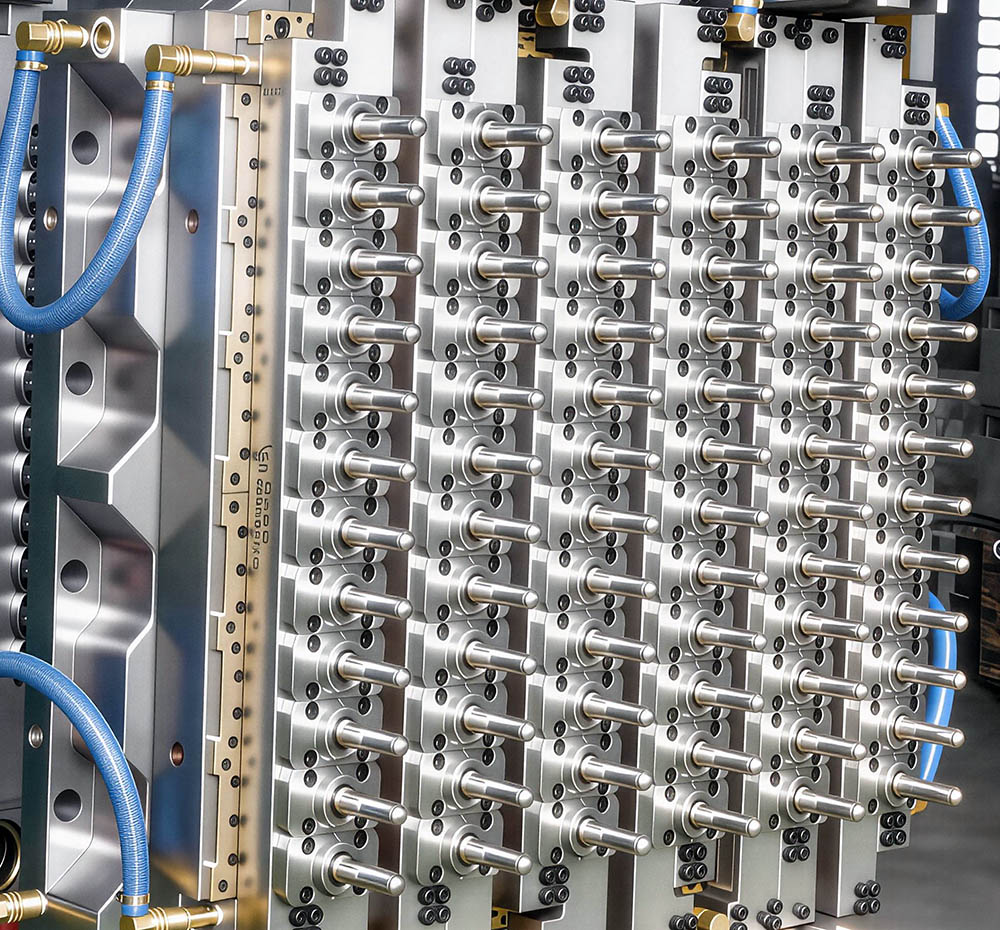
Understanding Core and Cavity Alignment in Multi-Cavity PET Preform Injection Molds
Executive Summary
In high-speed PET preform manufacturing, concentricity between the core, neck ring, and cavity is the fundamental determinant of preform quality, wall thickness uniformity, and overall blow molding efficiency. Even micro-scale misalignments (>0.015mm) lead to severe structural defects, non-uniform axial stretch ratios, sidewall thickness variation, thermal imbalance, and costly downtime. As a premier specialist in high-cavitation PET Preform Moulds and Plastic Cap Moulds, Berni Mould presents an in-depth technical analysis on the mechanical, thermal, and hydraulic forces governing core-cavity alignment, accompanied by engineered design solutions that guarantee zero-shift concentricity in multi-cavity production lines.
1. The Critical Role of Concentricity in Multi-Cavity PET Preforms
During the injection phase of a high-cavitation PET preform mold (ranging from 16 to 128 cavities), molten PET resin is injected into the cavity at ultra-high pressures, typically exceeding 120–160 bar. Because PET preforms feature tall, slender core pins designed for high axial stretch ratios during Stretch Blow Molding (SBM), the core pin acts as a cantilever beam exposed to massive asymmetric hydrodynamic shear forces.
If the alignment mechanism fails to maintain strict concentricity between the core pin, neck ring splits, and cavity insert, three primary failure modes occur:
- Eccentric Wall Thickness (Wall Variation): Uneven flow resistance causes one side of the preform wall to become thicker than the opposite side. During stretch blowing, thin walls heat faster and over-stretch, while thick walls remain cold and under-stretched, resulting in burst bottles or defective stress distribution.
- Neck Finish Deformity & Cap Sealing Leaks: Misalignment between the neck ring and cavity introduces ovality or flash at the thread finish. When paired with plastic caps—even high-precision caps produced by Berni Cap Moulds—the sealing lip fails to achieve uniform compression, resulting in gas loss in Carbonated Soft Drinks (CSD) or liquid leakage.
- Premature Mold Wear & Core Bending: Micro-collisions between the core pin and cavity gate area accelerate steel fatigue, scoring, and premature tool failure, leading to unplanned production stoppages.
2. Engineering Analysis: Factors Driving Core Deflection & Misalignment
Maintaining concentric tolerance within ±0.005mm across all cavities requires addressing three dynamic physical phenomena:
| Force / Driver | Physical Mechanism | Direct Impact on Preform Quality |
|---|---|---|
| Asymmetric Gate Flow | Imbalance in multi-gate hot runner pressure or thermal variance across nozzle tips causes unequal melt front arrival. | Lateral hydrostatic pressure pushes the slender core pin off-center (core shift). |
| Thermal Expansion Gradient | Differential expansion between the hot manifold plate (180°C–280°C) and cooled cavity plate (8°C–12°C). | Pitch misalignment across outer cavities in high-cavitation plates (e.g., 72 or 96 cavities). |
| Clamping Force Deflection | Elastic deformation of machine platen and mold backing plates under high clamping force (250–500+ tons). | Micro-tilting of neck ring splits and core positioning bases during high-speed clamping cycles. |
3. Berni Mould’s Engineered Alignment Solutions
To overcome core shift and maintain absolute concentricity across hundreds of thousands of cycles, Berni Mould integrates advanced European-grade tooling methodologies into every PET Preform Mould and Cap Mould project:
A. Taper Interlock & Double-Positioning Core-Cavity Architecture
Standard molds rely on single-taper alignment, which degrades under thermal stress. Berni Mould utilizes a proprietary dual-taper precision locking system for each individual cavity insert:
- Primary Taper Lock: Direct taper contact between the neck ring slide and cavity top ensures rigid alignment of the preform neck finish before resin injection starts.
- Secondary Core Taper: A hardened taper guide on the core base engages directly into the neck ring pocket, constraining core movement in X-Y planes with ±0.003mm repeatability.
B. Premium Swiss S136 Stainless Steel & Cryogenic Heat Treatment
Alignment precision is only as durable as the steel supporting it. Berni Mould manufactures all core pins, cavity inserts, and neck rings using genuine imported Swiss Stavax S136 / ESR stainless steel (vacuum hardened to HRC 52–54). Sub-zero cryogenic tempering eliminates residual austenite, ensuring zero dimensional shift under continuous thermal cycling.
C. Conformal Cooling & Uniform Thermal Expansion
Uneven cooling causes localized thermal expansion differences that twist core alignment. Berni Mould incorporates 3D conformal cooling channels in core pins and neck rings. Water flows in close proximity to the entire preform profile, removing heat uniformly and stabilizing structural alignment during rapid mold opening and closing.
4. Synergistic Cap & Preform Precision: The Berni Advantage
A preform’s thread and neck finish must perfectly match its closure. As an integrated manufacturer of both PET Preform Moulds and Plastic Cap Moulds (including CSD caps, hot-fill caps, sports flip-top caps, and 5-gallon closures), Berni Mould provides a complete system-level guarantee:
- System Matching: Thread profiles on preform neck finishes and cap inner threads are co-engineered using unified CAD/CAM models, ensuring optimal thread pitch engagement and torque-to-seal consistency.
- Zero-Leakage Integrity: By holding preform neck concentricity within 0.008mm, our cap moulds achieve flawless sealing plug contact without over-stressing the plastic cap threads.
"True efficiency in high-speed bottling relies on micro-precision tooling. At Berni Mould, our core and cavity alignment systems eliminate core shift at the source—delivering lightweight preforms with uniform wall thickness and maximum SBM stretch yield."
5. Conclusion for Bottlers & Injection Molders
Achieving defect-free preforms and lightweighting success requires selecting a mold partner that understands the complex physics of core deflection and high-cavitation alignment. Berni Mould’s precision-engineered PET preform moulds and cap moulds empower global beverage producers, water bottlers, and packaging converters to achieve faster cycle times, zero-defect bottle blow rates, and extended tool lifespan.