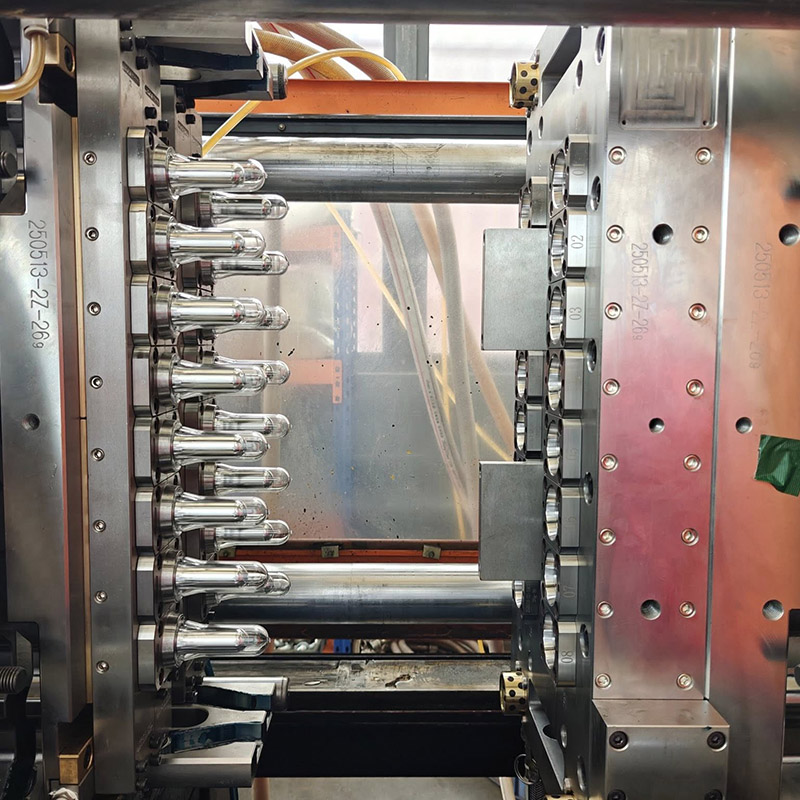
Coated Inserts and Heat Treatment Techniques to Prevent Wear in High-Cavitation Tooling
In modern high-speed industrial manufacturing, high-cavitation PET preform molds and plastic cap molds operate under extreme mechanical and thermal cycles. Producing tens of thousands of packaging components daily requires tooling that withstands severe clamping forces, aggressive abrasive wear from high-throughput PET resin injection, and continuous thermal fatigue. At Berni Mould, as a specialized PET mold manufacturing expert, we emphasize that mold longevity and dimensional stability directly depend on advanced metallurgy, precision heat treatment protocols, and high-performance surface-coated inserts.
1. The Mechanical and Thermal Challenges of High-Cavitation Tooling
High-cavitation injection molds—ranging from 32-cavity to 96-cavity configurations—experience immense cyclical stress. During each injection cycle, core and cavity inserts face:
- Abrasive Polymer Flow: Molten PET resin flowing at high velocity under high pressure causes localized micro-abrasion along gate areas and parting lines.
- Thermal Shock & Fatigue: Rapid cooling channels subjected to alternating thermal gradients cause expansion and contraction, creating micro-cracks in core inserts.
- Clamping and Ejection Friction: Repetitive mechanical rubbing between sliding components accelerates galling and surface degradation if surface hardness is insufficient.
2. Advanced Heat Treatment Protocols for Core & Cavity Steels
Selecting premium steel grades (such as pre-hardened stainless steel 1.2085, or premium grade DIN 1.2344 / H13) is only the first step. Proper heat treatment transforms raw steel into durable, wear-resistant tooling components capable of enduring millions of cycles without flashing or dimensional drift.
At Berni Mould, our heat treatment methodology incorporates:
- Vacuum Hardening & Tempering: Ensures uniform grain refinement across all cavities, achieving a core hardness of 48–52 HRC while maintaining exceptional toughness to resist impact fracture.
- Sub-Zero (Cryogenic) Treatment: Relieves retained austenite trapped within the steel matrix, converting it into stable martensite to maximize dimensional stability and wear resistance.
- Controlled Nitriding: Imparts an ultra-hard diffusion layer on pin and core surfaces, significantly lowering friction coefficients and preventing adhesive wear during high-speed core pulling and ejection.
3. Surface-Coated Inserts: Enhancing Durability and Release Properties
To push tool life beyond standard thresholds, applying advanced Thin-Film Coatings (PVD/CVD) onto high-wear insert zones represents a revolutionary breakthrough. These coatings provide an exceptional barrier against chemical attack and abrasive friction.
| Coating Technology | Key Characteristics | Primary Application in Tooling |
|---|---|---|
| TiAlN (Titanium Aluminum Nitride) | High oxidation resistance, excellent hot hardness up to 800°C. | High-cavitation PET preform core inserts and gate regions. |
| DLC (Diamond-Like Carbon) | Extremely low coefficient of friction, high anti-galling properties. | Thread splits and sliding components in high-speed plastic cap molds. |
| CrN (Chromium Nitride) | Superior corrosion resistance against acidic volatiles and balanced toughness. | Venting areas and cooling-intensive core surfaces prone to oxidation. |
4. Why Partner with Berni Mould for Your Packaging Tooling Needs?
Designing and manufacturing high-cavitation molds requires a deep understanding of thermodynamics, fluid dynamics, and precision machining. As an industry-leading PET preform and cap mold specialist, Berni Mould delivers turnkey manufacturing solutions customized to global packaging standards.
The Berni Mould Advantage:
- Custom Engineering & Flow Simulation: Mold designs optimized using advanced CAE analysis to ensure balanced filling and uniform cooling.
- Uncompromising Material Standards: Utilizing certified European and premium domestic steels engineered for high-cavitation endurance.
- Strict Quality Control: CMM dimensional inspection and rigorous pressure testing prior to global delivery.
5. Conclusion
Preventing premature wear in high-cavitation tooling requires an integrated approach combining premium steel selection, precision vacuum heat treatment, and specialized PVD/CVD coated inserts. By investing in these advanced metallurgical techniques, packaging manufacturers can eliminate unscheduled downtime, reduce maintenance overhead, and ensure consistent, high-volume production quality. Trust Berni Mould to engineer the high-performance PET preform and cap mold solutions your business demands.