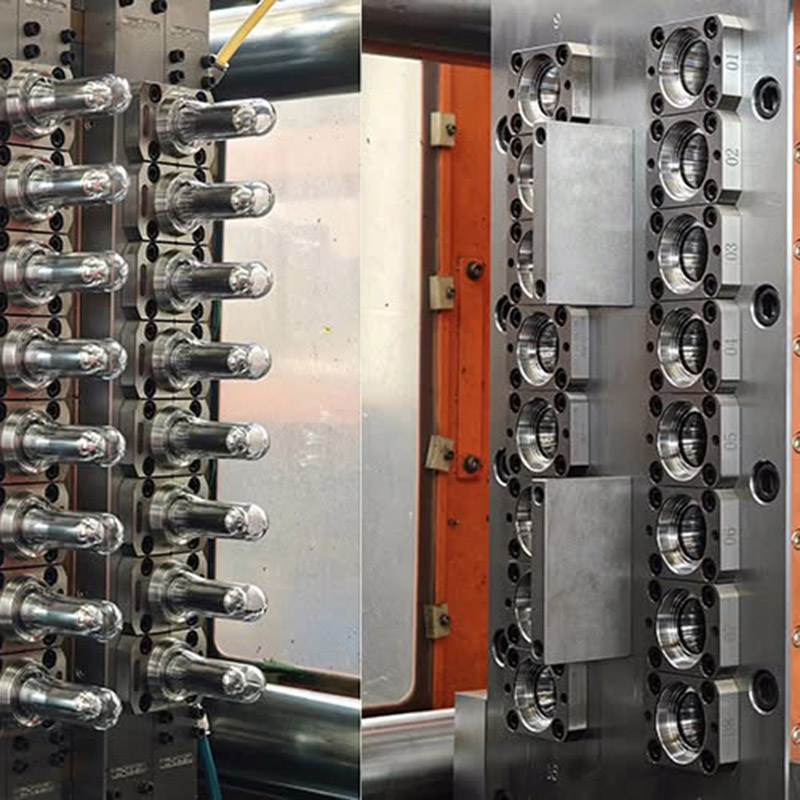
Key Takeaway: rPET is not a drop-in material. It demands molds engineered as contaminant isolation and thermal history controllers—not just shaping tools. Berni Mould designs preform and closure molds that accommodate 30% to 100% rPET while maintaining food-grade acetaldehyde limits below 5 ppm.
Why rPET Is Not a Drop-In Material
The global push toward recycled content in beverage packaging has made rPET compatibility a non-negotiable requirement for preform and closure molds. However, treating rPET as a direct substitute for virgin PET is the single most common engineering error we encounter at Berni Mould.
The fundamental issue is molecular variability. Post-consumer rPET arrives with a broader intrinsic viscosity (IV) distribution than virgin resin. While virgin PET used in bottle-grade applications typically maintains an IV between 0.76 and 0.84 dL/g, mechanically recycled rPET may range from 0.60 to 0.78 dL/g depending on feedstock quality and recycling history. When IV drops below approximately 0.72 dL/g, stretching stress during blow molding rises sharply, and preform rupture risk increases.
This variability is not a single parameter problem. It is a process system problem that manifests in three critical areas: thermal degradation, acetaldehyde generation, and crystallization kinetics. Each demands specific mold design countermeasures.
The Acetaldehyde Problem: Mold Design as Degradation Control
Acetaldehyde (AA) is the most consequential taste and odor defect in PET packaging. The challenge intensifies with rPET because recycled material carries a higher thermal history and residual catalyst activity that accelerates AA formation during melt processing.
The industry baseline for food-grade preforms requires AA levels at or below 5 ppm when measured on a ground preform molded at 285°C barrel temperature and approximately 2 minutes residence time. Achieving this with high rPET content demands mold-level intervention.
Berni Mould's Approach
We design hot runner systems with minimized dead spots and optimized residence time distribution. Stagnant melt zones in the manifold are where degradation begins. Every internal flow path in a Berni Mould hot runner is designed for continuous sweep, eliminating the crevices where rPET melt can linger, oxidize, and generate AA.
Complementing the hot runner design, our gate area cooling architecture accelerates solidification at the injection point. The gate region experiences the highest melt temperature and the longest residence time during the injection cycle. By engineering differential cooling at the core tip—prioritizing heat extraction from the gate area—we reduce the thermal window in which AA precursors convert to free acetaldehyde.
Validation from material science supports this direction: reducing melt processing temperature from 285°C to 260°C through process aids has been shown to reduce AA levels by up to 80%. Berni Mould's thermal management design creates the physical precondition for this temperature reduction by ensuring uniform cooling and preventing hot spots that force higher barrel temperatures.
IV Variation and the Crystallization Challenge
Intrinsic viscosity loss during recycling directly affects stretch blow moldability. The data are unambiguous: MR-PET with IV values of 0.72 dL/g blow molded successfully, while the same material with IV dropping to 0.60–0.72 dL/g under high stress conditions (19.55 MPa at 5× stretch ratio) resulted in preform rupture.
The crystallinity implication is equally significant. Lower molecular weight PET crystallizes faster. In hot-fill and pasteurization applications, the preform neck finish must maintain dimensional stability at temperatures up to 90°C. This requires a crystalline neck finish while the body remains amorphous for blow molding flexibility.
Berni Mould's Engineering Solution for rPET Compatibility
Our design involves thermal isolation between mold zones. We separate the neck finish cooling circuit from the body cavity circuit using low thermal conductivity inserts at the mating surfaces. This allows:
| Zone | Target Condition | Mold Design Approach |
|---|---|---|
| Neck Finish | Crystalline (dimensional stability) | Independent heating circuit, isolated thermal path |
| Body | Amorphous/semi-crystalline (stretchability) | Accelerated cooling, maximum heat transfer |
| Gate Area | Rapid solidification (AA control) | Bubbler cooling at core tip, thin-wall mandrel design |
This zoned thermal architecture means the same mold can produce preforms suitable for both standard and hot-fill applications, regardless of rPET content percentage.
Drying and Moisture: The Upstream Requirement
PET is hygroscopic. Water molecules absorbed into the resin form intermolecular bonds that cause hydrolytic chain scission when heated above melt temperature. For rPET, the problem compounds because post-consumer material often arrives with elevated surface moisture and condensable contaminants.
The drying requirement for rPET is more demanding than for virgin resin. Residual moisture must be reduced to 50 ppm or below—ideally to the 0.01–0.02% range (100–200 ppm) before injection—using staged heating that first removes surface moisture, then promotes internal moisture migration, and finally achieves deep dehumidification.
Berni Mould's Position: While drying is an upstream resin preparation step, mold design cannot compensate for inadequately dried material. We specify the moisture window in our mold qualification documentation and recommend continuous vacuum drying systems capable of achieving ≤45–50 ppm residual moisture for rPET feeds. This is not optional for food-grade applications.
Design Considerations for Closure Molds with rPET
The shift toward rPET is not limited to preforms. Beverage closures increasingly incorporate recycled content, and closure molds face their own compatibility challenges.
rPET demands more precise thermal and flow control than virgin material. Batch-to-batch variability in the recycled feedstock means process windows narrow, and molders require tooling that can absorb some of that variability through design robustness.
Berni Mould's Closure Mold Engineering for rPET
- Balanced flow manifolds to ensure uniform filling despite melt viscosity fluctuations
- Precise thermal control with individual zone PID tuning capability
- Valve gate designs with timing precision for cosmetic-critical applications
- Dead-spot minimization to prevent degradation in the runner system
These design principles align with the industry direction: valve-gated hot runner systems provide a wider safety margin for shear-sensitive rPET and lower total cost of ownership despite higher initial investment.
Compatibility Testing Protocol
Berni Mould recommends a structured validation protocol before full production commitment:
- IV and moisture verification of incoming rPET feedstock
- AA baseline measurement on trial preforms using ASTM F2013-00 methodology
- Crystallinity analysis (DSC) of neck finish regions
- Stretch ratio window testing at production blow molding line speeds
- Bottle performance validation (CO₂ retention, stress cracking, top load)
This protocol applies whether the target is 30% rPET for compliance or 100% rPET for circular economy leadership.