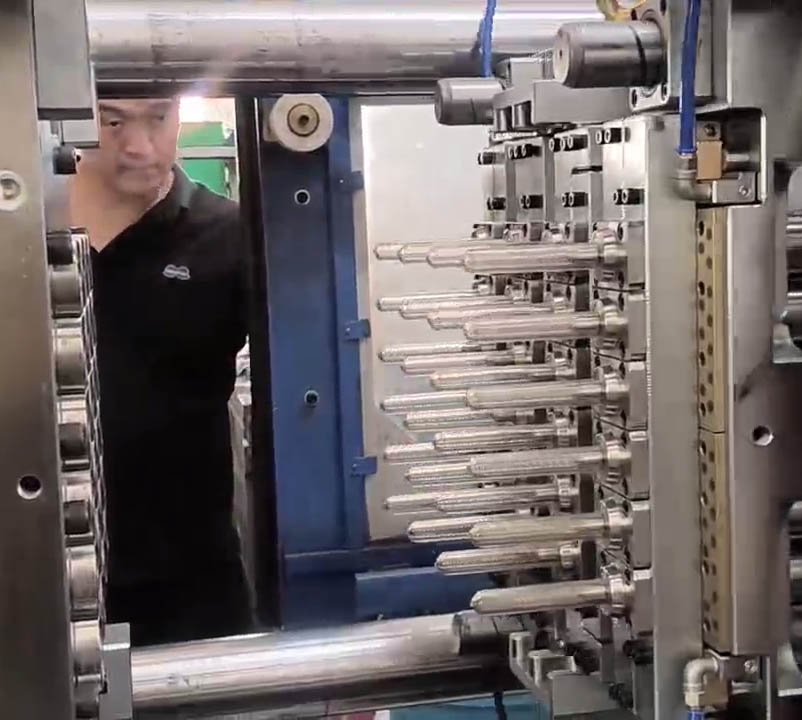
A deep technical analysis from Berni Mould — your professional PET preform mold and bottle cap mold solution expert.
In the highly competitive world of PET packaging, the mold is not merely a tool; it is the precision heart of production efficiency and product quality. For manufacturers running multi-cavity PET preform molds, the pursuit of perfect concentricity, minimal eccentricity, and extended tool life is relentless. Among the most critical yet often under-discussed engineering features enabling these goals is the self-locking structural design. This article provides an in-depth analysis of how this mechanism works in high-cavitation molds, why it is indispensable for premium preform production, and how Berni Mould integrates this technology to deliver superior mold performance.
What Is a Self-Locking Structure in a PET Preform Mold?
In a multi-cavity injection mold, each cavity must be perfectly aligned with its corresponding core to produce a preform with uniform wall thickness. Any misalignment—often caused by injection pressure, thermal expansion, or mechanical wear—leads to eccentricity, inconsistent cooling, and ultimately weaker bottles or blowout failures. The self-locking structure (often referred to as independent cavity self-locking or self-clamp) is a mechanical design where each individual cavity insert is equipped with a locking mechanism that engages during mold closure. This ensures that every single cavity is independently centered and secured, rather than relying solely on the overall mold base alignment.
Industry-standard descriptions of advanced preform molds frequently highlight that “each cavity self-locks independently” to guarantee low decentration and high concentricity [citation:1][citation:3][citation:4]. This is not a marketing gimmick; it is a fundamental engineering solution to the inherent challenges of high-cavity-count tooling.
The Engineering Mechanics: How Self-Locking Works
The typical self-locking design in a high-quality PET preform mold involves a two-stage or dual-taper locating system. When the mold closes, the core and cavity components are guided into position by precision tapers. The self-locking element—often a split lock ring or a tapered interlock—then engages, rigidly holding the cavity insert in its optimal position relative to the core.
Key Technical Components of a Robust Self-Locking System:
- Dual-Taper Locating: Utilizes two distinct tapered surfaces to guide and then rigidly lock the cavity, compensating for minor misalignments during the high-speed closing motion.
- Independent Cavity Shut-Off: Each cavity has its own shut-off mechanism, preventing material leakage and ensuring uniform gate vestige across all cavities [citation:1][citation:11].
- Wear-Resistant Materials: Components are typically made from hardened stainless steel (such as S136 or equivalent) with hardness ratings often exceeding HRC 48-52 to withstand repeated locking cycles without deformation [citation:1][citation:4].
Advanced mold makers emphasize that the locking mechanism must be designed to avoid friction during the opening and closing phases. For instance, some Swiss designs focus on the dynamic separation in the stack, ensuring that the core is positioned without contacting other stack parts during the mold movement, thereby drastically reducing wear and extending maintenance intervals [citation:9]. While Berni Mould employs optimized geometries and surface treatments to achieve similar friction reduction, the core principle remains: precision locking without parasitic wear.
Why Multi-Cavity Molds Demand This Technology
As cavity counts increase from 16 to 48, 72, or even higher, the cumulative effect of small misalignments becomes catastrophic. A single eccentric cavity in a 72-cavity mold can produce hundreds of thousands of defective preforms per week. The self-locking design addresses several critical pain points:
- Concentricity and Wall Thickness Control: By locking each cavity independently, the design ensures that the core is perfectly centered within the cavity. This is directly responsible for maintaining preform thickness differences to within ±0.05mm or less, a specification frequently demanded in high-precision beverage and pharmaceutical packaging [citation:1][citation:11].
- Compensation for Thermal Expansion: During production, the hot runner and mold plates expand. A rigid, non-self-locking design can bind or misalign. The self-locking structure, with its tapered engagement, allows for slight accommodating movement while maintaining alignment, preventing gate quality issues and core shifting.
- Extended Mold Life and Reduced Maintenance: By preventing relative movement between the core and cavity during injection and cooling, the self-locking design reduces wear on the most critical and expensive components—the cavity inserts and core pins. This is a key factor in achieving mold lives of 5 million shots or more, as advertised by leading mold manufacturers [citation:4][citation:11].
Berni Mould’s Expertise in Self-Locking and Overall Mold Integrity
At Berni Mould, we understand that a self-locking structure is only as effective as the entire mold system surrounding it. Our approach to multi-cavity PET preform mold design integrates the self-locking principle with several other critical technologies to deliver a holistic solution for bottle cap and preform manufacturers.
- Premium Materials Selection: We utilize high-quality mold steels such as S136 for cavity, core, and neck inserts, hardened to HRC 48-52. This ensures the locking tapers and shut-off surfaces remain dimensionally stable over millions of cycles, resisting corrosion and wear [citation:1][citation:4].
- Balanced Hot Runner Integration: A self-locking cavity is useless if the melt delivery is unbalanced. Our molds feature independently temperature-controlled hot runner nozzles and balanced manifold designs. This ensures that each cavity, securely locked in place, receives an identical shot of PET melt, preventing short shots or material degradation that could lead to acetaldehyde (AA) generation [citation:1][citation:5].
- Optimized Cooling for Cycle Time: The locking mechanism must not interfere with cooling. Our designs incorporate independent cooling circuits for the cavity, core, and neck insert. This targeted cooling, combined with the dimensional stability provided by the self-locking structure, allows us to achieve consistent cycle times as low as 15-18 seconds (depending on preform weight and machine capabilities) [citation:1][citation:4].
- Precision Manufacturing and Off-Center Adjustment: While the self-locking structure provides the baseline alignment, we also integrate fine off-center adjustment systems. This allows for micro-adjustments during mold trials to ensure that the final preform thickness variation is minimized to the absolute lowest possible tolerance [citation:1].
Conclusion: The Self-Locking Advantage
For producers of PET bottles, jars, and caps, the choice of mold technology directly impacts profitability. The self-locking structural design in a multi-cavity PET preform mold is a hallmark of high-end engineering. It transforms a collection of individual cavities into a synchronized, precision production system. By investing in molds that feature robust independent cavity self-locking, manufacturers gain the assurance of consistent quality, reduced scrap rates, lower maintenance costs, and a longer productive life from their most critical tooling asset.
As a dedicated PET preform mold and bottle cap mold solution expert, Berni Mould engineers every mold with these principles at its core. We do not just supply molds; we deliver precision-engineered systems designed for the rigorous demands of modern PET packaging. For a detailed technical consultation on your next multi-cavity preform project, contact our engineering team.