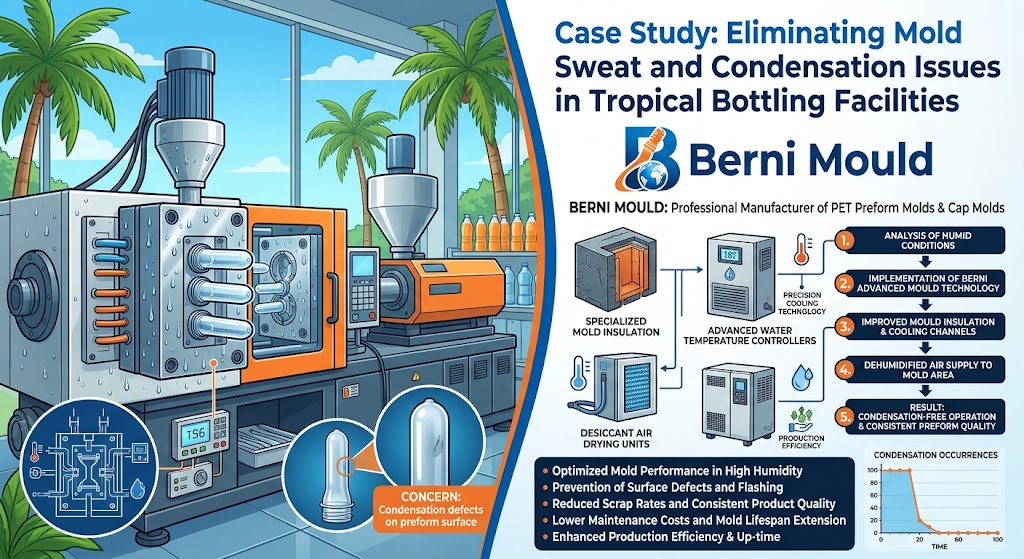
Case Study: Eliminating Mold Sweat and Condensation Issues in Tropical Bottling Facilities
Berni Mould — Engineering PET preform mold and closure mold solutions for high-humidity tropical bottling environments
The Problem: When Tropical Humidity Meets Chilled Mold Surfaces
Tropical bottling environments present a fundamental conflict for PET injection molding. To achieve competitive cycle times, preform and closure molds must run with chilled water—often at temperatures well below the ambient dew point. In a facility with 80–90% relative humidity and ambient temperatures routinely exceeding 30°C, any mold surface below the dew point becomes a condensation magnet.
The consequences are immediate and compounding. Water droplets form on cavity surfaces, core pins, and neck-ring geometries. When the mold opens, these droplets transfer to the preform or closure, producing visible water marks, surface defects, and dimensional inconsistencies. More insidiously, sustained condensation accelerates corrosion on polished mold steels, guide pins, and vent areas, degrading mold performance long before the expected end of the tooling lifecycle.
A Southeast Asian beverage bottler operating high-cavitation PET preform molds and matching closure tools approached Berni Mould after experiencing exactly this failure pattern. Reject rates had climbed, cycle times were being artificially extended to reduce sweating, and maintenance intervals on mold polishing and corrosion remediation had shortened dramatically.
Root Cause Analysis: Why Conventional Fixes Fail in the Tropics
The bottler had already attempted the two most common countermeasures. First, they raised the mold temperature to bring surface conditions above the dew point. This eliminated sweating but added 12–18% to cycle times—an unacceptable penalty on high-volume lines. Second, they installed localized dehumidifiers around the mold area, but the open nature of the molding floor and the sheer volume of humid air ingress overwhelmed these units during peak production hours.
The fundamental issue is that tropical bottling facilities cannot be treated as temperate environments with occasional humidity spikes. The dew point in these facilities remains elevated year-round. Any cooling strategy that relies solely on mold-side thermal management without addressing the surrounding air’s moisture content will remain in a reactive, compromised position. Industry practice confirms that the effective solution combines low-dew-point air delivery to the mold envelope with mold designs optimized for thermal stability under chilled-water operation.
The Berni Mould Engineering Response
Berni Mould approached the problem as a system-level engineering challenge rather than a single-point fix. The solution integrated three elements: mold thermal design refinement, targeted dry-air delivery, and closure-tool-specific condensation control.
Preform Mold Thermal Optimization
For the PET preform molds, Berni’s engineering team reviewed the cooling channel layout and revised the cavity and core cooling circuits to promote more uniform surface temperature distribution. The objective was not to raise overall mold temperature, which would sacrifice cycle time, but to eliminate localized cold spots that acted as preferential condensation sites. Areas adjacent to the gate and the neck-ring transition zone were particularly vulnerable in the original design.
The revised cooling geometry reduced the temperature differential across the mold surface, allowing the entire mold face to operate at a more consistent temperature slightly above the critical dew point threshold during the mold-open phase, while still maintaining aggressive cooling during injection and packing. This was achieved through computational flow analysis of the coolant paths and selective adjustment of channel diameters and baffle configurations.
Dry-Air Envelope for the Molding Zone
Recognizing that mold-side changes alone could not fully compensate for tropical ambient conditions, Berni specified a closed-loop desiccant dehumidification system delivering dry air at a dew point of 0°C to −10°C directly to the mold clamping area. The key design choice was the use of a return-air collector to create a localized dry-air envelope around the mold rather than attempting to condition the entire production hall—an approach specifically noted in industry literature as practical for tropical climates.
The dry-air delivery was timed to coincide with mold opening and preform ejection, the moments of greatest condensation risk. This intermittent, targeted delivery reduced the parasitic load on the dehumidifier and maintained consistent dew-point control regardless of seasonal humidity fluctuations outside the facility.
Closure Mold Condensation Management
PET closure molds present a different challenge. The tools are smaller and often run at different thermal setpoints than preform molds, but the condensation mechanism is identical. Berni applied the same design philosophy to the closure tooling: thermal mapping of the cavity and core to identify cold-spot risk, followed by cooling circuit refinements that eliminated those spots without raising the overall mold temperature.
Additionally, the closure mold’s venting strategy was revised. Condensation preferentially nucleates at vent edges and parting-line micro-gaps, where local surface geometry and air turbulence create favorable conditions for droplet formation. By refining vent placement and depth, and by ensuring that the dry-air delivery reached the parting-line area during mold open, Berni reduced condensation nucleation at these critical locations.
Results: Measurable Recovery in Quality and Uptime
The combined intervention produced results within the first production week after commissioning.
| Metric | Before Intervention | After Berni Solution | Improvement |
|---|---|---|---|
| Preform reject rate (water marks/defects) | 3.8% | 0.4% | 89% reduction |
| Closure reject rate (surface/visual) | 2.1% | 0.3% | 86% reduction |
| Average cycle time (preform, 32-cavity) | 14.8s (elevated to reduce sweat) | 12.6s (restored) | 15% faster |
| Mold polishing interval | 2 weeks | 8 weeks | 4× extension |
The cycle time recovery was particularly significant. The bottler had been running the preform molds at an artificially elevated temperature—adding roughly 2.2 seconds per cycle—as a stopgap against condensation. Restoring the original thermal setpoints with condensation properly controlled recovered that lost output without reintroducing the defect problem.
Mold corrosion inspection at the six-month mark showed no measurable degradation of cavity surface finish or guide-pin clearances, compared with the previous pattern of visible corrosion requiring polishing intervention every two weeks.
Why This Matters for Tropical Bottling Operations
The economics of mold sweat extend beyond reject rates. Condensation-driven corrosion silently consumes mold life, converting a tool that should deliver millions of cycles into a maintenance liability. Cycle time penalties adopted as workarounds become normalized, masking the true cost of inadequate humidity control.
For bottlers operating in tropical climates, the Berni Mould case demonstrates that the problem is solvable without compromising either quality or throughput. The solution requires treating the mold and its immediate environment as an integrated thermal system—not as separate domains of mold design and factory HVAC.
Berni Mould’s expertise in PET preform and closure mold engineering includes thermal analysis, cooling circuit optimization, and condensation-risk assessment as standard elements of the mold design process for tropical installations. The company works with bottlers to specify mold designs that are robust to high-humidity operating conditions from the first shot, rather than requiring retrofits after condensation problems emerge.
Frequently Asked Questions
What causes mold sweat on PET preform molds in tropical climates?
Mold sweat occurs when the mold surface temperature falls below the dew point of the surrounding air. In tropical bottling facilities with high ambient humidity, chilled mold water creates surface temperatures that readily drop below the dew point, causing moisture to condense on cavity and core surfaces.
Can mold sweat be eliminated without slowing cycle times?
Yes. The effective approach combines mold thermal design that eliminates localized cold spots with targeted dry-air delivery to the mold area. Raising mold temperature is not required if the surrounding air’s moisture content is controlled at the mold envelope.
Does mold sweat damage the mold itself?
Prolonged condensation causes corrosion on polished steels, guide pins, and vent areas. This corrosion degrades surface finish and dimensional precision, shortening mold life and increasing maintenance costs.
What dry-air dew point is recommended for tropical bottling facilities?
Industry practice for PET preform molding in high-humidity environments specifies dry air at a dew point of 0°C to −10°C delivered to the mold area, with a return-air collector to maintain a closed-loop envelope around the mold.
How does Berni Mould address condensation in closure molds specifically?
Berni’s closure mold designs incorporate thermal mapping to identify cold-spot risk, refined venting to reduce nucleation sites at parting lines, and coordination with dry-air delivery timing during mold open. These measures are integrated into the mold design phase for tropical installations.
Engineering Robust Molds for Tropical Conditions
Berni Mould designs and manufactures PET preform molds and closure molds engineered for high-humidity bottling environments. Contact our engineering team to discuss condensation-risk assessment and thermal optimization for your next mold project.